
The Exit Was Already Planned Before You Noticed the Welcome Had Changed
Black women are not imagining the gradual withdrawal of welcome. The signals are real, they are deliberate, and its pervasiveness is more than merely an “affordability” matter.


They never have to say "we don't want you." They raise the deposit. They change the booking system. They retrain the staff. They rebrand. And they count on you to stay uncertain about all of it.
If they needed your loyalty to grow, why is your uncertainty about the exit so profitable for them now?
The Exit Was Already Planned
There is a particular kind of shift that does not arrive with an announcement. It arrives in the quality of the greeting. In the new deposit requirement. In the third time a policy exception that used to be extended without discussion is now declined with scripted language. It arrives in the atmosphere of a room you have spent real money in for real years, in the way the space no longer seems to be arranged with you in mind.
Most people dismiss this early. They call it a bad day, or a hard season, or the market. Some keep spending while the welcome contracts around them. And the businesses that depend on that hesitation understand it very well.
SIGNALS HAVE ALWAYS DONE THE WORK THAT WORDS CANNOT
Outright exclusion is legally and socially costly. What replaced it was subtler and more durable: a set of practices that collectively communicate departure without requiring anyone to state it. You do not have to tell a longtime client she is no longer the clientele you want. You price her differently, accommodate her less, make the experience slightly more difficult at each touchpoint until the calculation she is forced to make becomes: is this still worth it?
The answer the business is counting on is that she will not be sure. And unsure keeps her paying.
The signals look like this, and more than one can arrive at the same time:
Policies tighten in ways that seem procedural but apply with unusual consistency to a specific type of client
Deposits and cancellation fees become tools for filtering rather than managing logistics
The booking system gets complicated in ways that favor clients with more time or more technical access
Customer service quality toward established clients declines in inverse proportion to the warmth extended to new ones
The branding quietly shifts to imagery, language, and aspirational positioning aimed at a different demographic
The physical atmosphere changes to reflect a clientele that has not yet arrived but is being courted
Long-term clients begin to feel, without being able to prove, that the room is no longer organized around their presence
None of these require a meeting. Many of them do not require intent. What they require is a direction, and someone keeping score on whether the right clients are arriving and the others are quietly leaving.
BEFORE YOU WALK: THE DIFFERENCE BETWEEN GROWING PAINS AND EXCLUSION
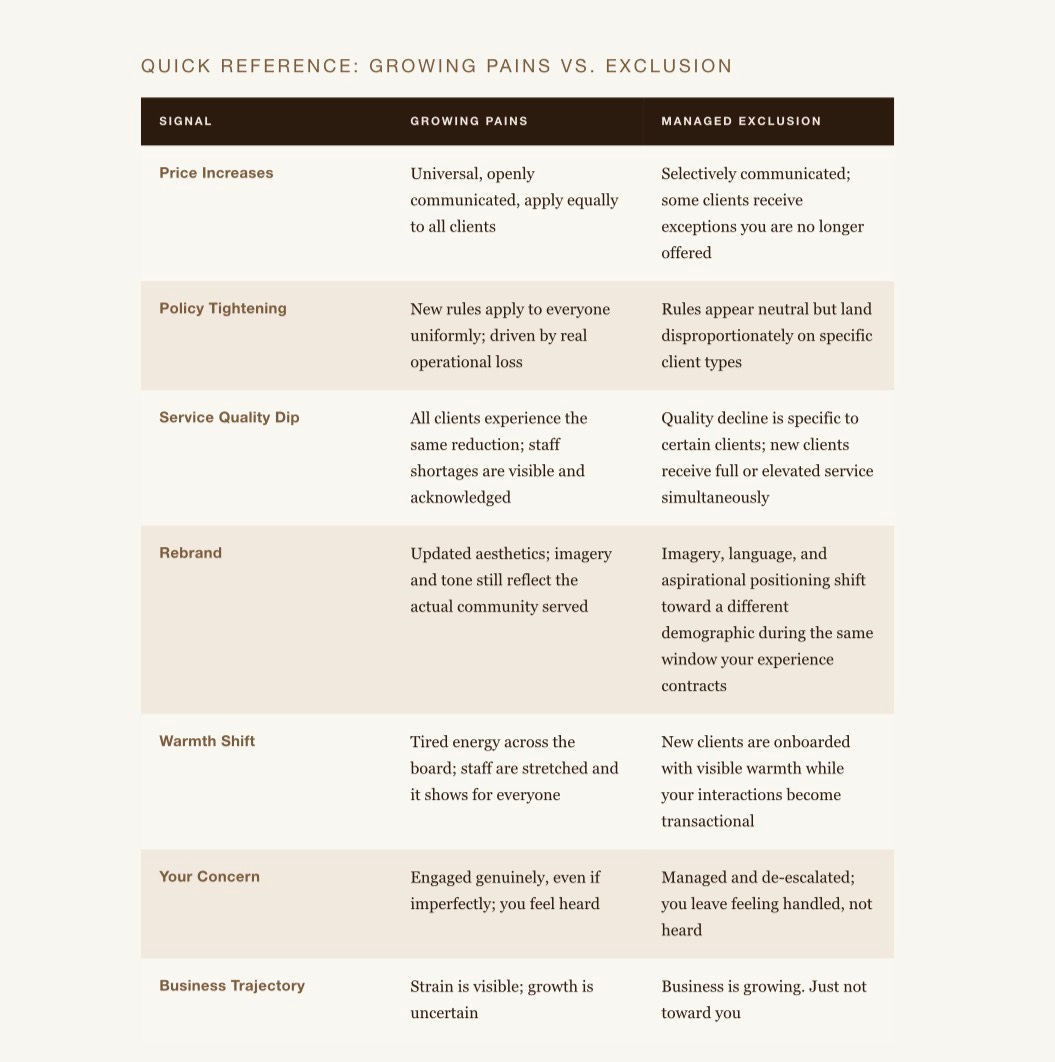
Here is the part that is worth slowing down on before you make a decision. Because not every price increase is a signal. Not every policy change is a managed departure. Businesses operate in the same economy you do, and some of what looks like withdrawal is, in fact, a business fighting to stay open. Conflating the two is a different kind of trap…one that costs you accuracy and costs the businesses that genuinely want to serve you, your continued support.
The distinction matters. Here is what it looks like on each side.
What legitimate growing pains look like:
Price increases are applied uniformly across the entire client base, with no tiering in how they are communicated or absorbed
A new deposit policy exists because the business took real losses from no-shows, and it applies to every booking regardless of who is booking
The booking system changed because the old one was a spreadsheet and the new one is software. Inconvenient, yes, but the aggravation felt is universal
Service quality dipped because they lost two staff members in three months, are training replacements, and everyone is stretched
The rebrand updated the logo and freshened the color palette…the imagery still reflects the actual clientele, the language still sounds like the community it serves
When you raise a concern, someone engages it. Not perfectly, but genuinely
The warmth is tired, not withdrawn. There is a difference
What managed exclusion looks like:
Policies tighten in ways that land harder on one type of client than another, even when written to look neutral
New clients receive accommodations, flexibility, and warmth that are no longer extended to you, even though you have been there longer and spent more
The rebrand did not just update aesthetics…it replaced the imagery, language, and tone with something that does not reflect you, during the same period your experience started to contract
Your concerns are acknowledged and then managed. You leave the conversation feeling like a problem that was handled, not a client that was heard
The service quality decline is specific. Your wait is longer. Your appointments are shorter. The energy in the room shifts when you enter it
Nobody is struggling the business is visibly growing. It is just growing toward someone else
The clearest diagnostic is simultaneity. When a business is going through genuine economic strain, the difficulty is distributed. Everyone feels it. Prices go up, but the owner also posts about it honestly. Service is slower for everyone because they are short-staffed. The atmosphere is worn, not curated differently by client type.
What exclusion produces is not distributed difficulty. It produces a split experience: one group is being managed through the inconvenience, and another is being managed toward the door, at the same time, in the same space. If new clients are arriving with warmth while established clients are experiencing contraction, that is not a hard season. That is a direction.
Give the business the honest read it deserves. If it is struggling and still treating you with care, that is worth something. If it is thriving and quietly reorganizing itself away from you, while still collecting your money. That is the situation this entire conversation is about.
THE CONTRADICTION THAT HAS BEEN IN PLACE FOR A LONG TIME
Certain industries did not grow neutrally. They grew specifically because Black women were loyal, consistent, and willing to spend on quality in categories that other demographics often treated as optional. Beauty. Wellness. Personal care. Service. Black women's documented spending in these categories is not incidental to the growth of those industries. It is foundational to it.
What happened next is what the conversation rarely says plainly. Some of those same industries, having grown on the foundation of that loyalty, are now repositioning toward what they call a "higher-end" or "elevated" clientele. The language is curated to sound like quality. What it often describes is a demographic migration. And the clients whose spending made the elevation possible are not invited to the new level. They are expected to continue funding the transition from the outside.
That is not evolution. That is extraction with extra steps.
“…She watched the spa she had used for three years launch a rebrand. New logo. New website copy full of words like curated and refined. New Instagram full of women who did not look like her. She told herself it was just marketing. She went back for her quarterly appointment and sat in the waiting room for thirty-one minutes past her scheduled time while two other clients were called in before her, both of whom had booked after she had. No one apologized. No one acknowledged it. She said nothing because she was not sure she had the standing to say something. She was, after all, still a paying client. She left that day having spent two hundred and forty dollars and feeling, precisely and unmistakably, like a guest who had overstayed. She did not book the next appointment. She spent the next three weeks convincing herself she was being unreasonable.…”
WHAT THE TIMING TELLS YOU
The most telling detail in this dynamic is when the experience shifts relative to the rebrand. If service quality had been declining uniformly, across all clients, for legitimate operational reasons, the timing would be scattered. What tends to happen instead is that the experience for certain clients degrades in parallel with the brand repositioning. The new clientele is being onboarded with warmth. The existing clientele whose demographics do not match the aspirational direction is being managed toward exit. Those two things are happening simultaneously, on purpose, because the revenue from the second group is still needed while the first group scales up.
You are not misreading the room. You are reading a transition plan.
WHO BENEFITS FROM YOUR CONTINUED UNCERTAINTY
The most clarifying question is not whether the signals are intentional. They usually are, even if no one involved would describe their choices that way. The more useful question is: who gains when you are not sure?
When you stay uncertain, you keep spending. When you keep spending while the welcome quietly withdraws, the business extracts full revenue from you while delivering a reduced experience and investing none of that revenue in retaining you. Your uncertainty is not a side effect of the situation. It is a resource the situation depends on. The hesitation, the self-questioning, the reluctance to name something that is plainly visible. All of it extends the window in which you continue to be useful without being valued.
That is not an accident. It is a feature.
Most of what gets said publicly about this centers on whether any specific business is guilty of discrimination. That framing is almost always inconclusive. It is also designed to be, because inconclusive keeps the revenue flowing.
What sustains this is not hatred in a boardroom. It is incentive in a spreadsheet. Someone decided that Black women's spending was worth capturing and their continued sense of belonging was not worth protecting. Those two decisions can coexist quietly inside a business strategy without ever requiring a single conversation…
